Event Discoveries: Why battery health could define the future of used EVs
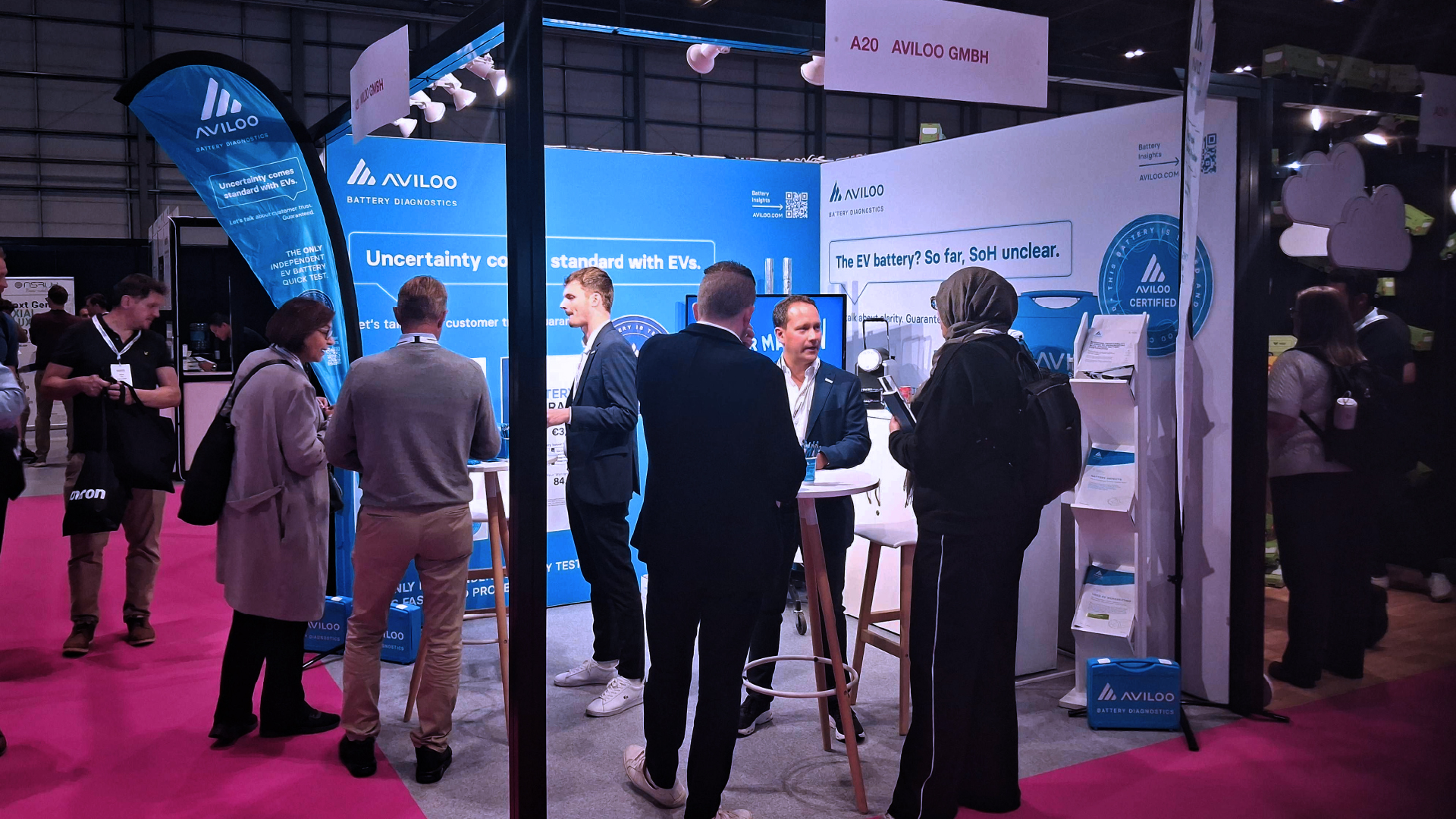
After meeting AVILOO at MOVE 2026, I spoke with Stefan Holzschuh and Alexandra Vieh about battery transparency, customer confidence, and why understanding battery health could become one of the most important developments in the used EV market.
When I visited MOVE 2026 in June, I spoke with companies working on everything from AI and autonomous driving to battery technology and EV charging infrastructure. It was exactly what you would expect from one of the industry's biggest events. Yet the product that stayed with me long after I had left wasn't the largest stand or the most ambitious concept. It was a small battery diagnostic device sitting on the AVILOO stand.
What caught my attention wasn't simply the hardware itself. It was the problem it was trying to solve. Anyone who has spent time speaking with prospective EV buyers will recognise one recurring concern. As electric vehicles begin to enter the used market in larger numbers, people are increasingly asking the same question: how do I know whether the battery is still healthy? It's an obvious question, yet surprisingly few people have a clear answer.
That curiosity led me to arrange a longer conversation with Stefan Holzschuh and Alexandra Vieh from AVILOO. I wanted to understand not only how their technology works, but why battery transparency is becoming such an important topic for the wider industry. The discussion quickly became about much more than diagnostics.
The challenge facing the used EV market
The used EV market is growing rapidly, and with that growth comes a new challenge. For decades, buyers have understood how to judge a used petrol or diesel car. Mileage, service history, ownership records and general condition all help build a picture of the vehicle. Electric vehicles are different. The battery is the single most valuable component in the car, yet for many buyers it remains something of an unknown. Two vehicles may have identical mileage, but completely different battery health depending on how they have been charged, driven and maintained throughout their lives.
That uncertainty affects far more than purchasing decisions. It influences vehicle valuations, dealer confidence, fleet management, leasing and residual values. Put simply, if buyers cannot trust the condition of the battery, confidence in the wider used EV market suffers.
According to Stefan, that was exactly the problem AVILOO's founders wanted to solve.
"Like many great companies, AVILOO started in a garage. We purchased a BMW i3 without knowing how good the battery still was. That's where everything began."
Today, the company employs more than one hundred people dedicated entirely to battery diagnostics, but its original ambition remains remarkably simple: remove uncertainty by giving buyers and sellers an independent assessment of battery health.
The real innovation isn't the box
One of the things I found most interesting during our conversation was discovering that the technology isn't really about the small diagnostic box at all. That's simply the visible part of the process. The real value lies in the enormous amount of battery data AVILOO has spent years collecting.
Before launching today's three-minute FLASH Test, the company developed what it calls the PREMIUM Test. Vehicles are charged to 100% before being driven down below 10%, allowing engineers to collect detailed data about how batteries behave throughout an entire discharge cycle. Over time, that has created one of the world's largest independent battery databases.
Alexandra states that the database is what truly separates AVILOO from the competition.
"The database we collect from the PREMIUM Tests is exactly our USP, and is also why the FLASH Test is so accurate."
It's an important distinction because AVILOO doesn't describe itself as a battery readout tool. Instead, as Alexandra put it, "We are not a readout. We are smart diagnostics."
Rather than simply reading the battery management system, the platform compares information against its own database, analyses battery performance at cell level and builds a much more complete picture of battery health. The result is an independent battery certificate that provides buyers and sellers with information that goes well beyond a simple State of Health percentage.
Why battery health isn't just a number
One of the most interesting parts of our discussion centred around how easy it is to oversimplify battery health. Many people assume there is a single figure that determines whether a battery is good or bad, but Stefan explained that reality is much more complicated.
"It's a multi-dimensional model and you only know it if you have the dynamic data in the background," he explained, describing how battery condition depends on numerous factors including battery type, vehicle model, mileage, charging behaviour and operating temperatures.
That makes perfect sense. Two vehicles with the same mileage may have experienced completely different lives. One may have spent years rapid charging in a hot climate, while another has been mostly slow charged overnight in cooler conditions. Looking at a single battery health percentage doesn't tell the full story.
This is why AVILOO focuses on diagnostics rather than simply reporting data. By comparing a vehicle against thousands of similar batteries and analysing performance down to cell level, the company is able to identify issues that might otherwise go unnoticed. It's a level of analysis that reflects how batteries actually behave in the real world.
Confidence changes everything
While we spent plenty of time discussing technology, both Stefan and Alexandra kept returning to the same word throughout our conversation: confidence.
Their goal isn't simply to help dealers perform battery diagnostics more efficiently. It's to give buyers the confidence to choose a used electric vehicle without worrying that the battery is an expensive unknown.
That philosophy is reflected in AVILOO's latest development. Every qualifying FLASH Test now includes a battery warranty backed by insurers, providing additional reassurance that the company is prepared to stand behind its own analysis. It's a logical next step. A certificate tells buyers what the battery looks like today, while the warranty provides confidence in what that battery is expected to do tomorrow.
The wider market appears to be moving in the same direction. AVILOO's recent B2B customer survey found that transparency, trust and independent verification are now among the biggest reasons dealers value battery certificates. Many reported that certificates make customer conversations easier, while others highlighted faster sales and increased buyer confidence. One example described how a Fiat 500e that had remained unsold for several months was sold within four days of receiving an independent battery certificate.
Alexandra believes the timing is right because consumer awareness is changing too.
"Things have changed over the last six or seven months. Consumers are asking more questions."
That shift is important. For years, battery diagnostics have largely been a conversation between dealers, leasing companies and fleet operators. Increasingly, however, end consumers are beginning to understand that battery health is one of the most important factors when buying a used EV.
Could battery certificates become the new service history?
It's difficult not to compare this to the way service histories evolved. Today, nobody questions the importance of documented maintenance when buying a used vehicle. It's simply expected. Battery health may well be following the same path. As electric vehicles become an increasingly common sight on forecourts, independent battery certificates could become just another standard part of the buying process.
When I first stopped to speak with Stefan at MOVE 2026, I thought I had discovered an interesting battery diagnostic product. After spending more time understanding the thinking behind AVILOO, I came away with a different conclusion. The company isn't simply measuring battery health. It's helping remove one of the biggest barriers to confidence in the used EV market.
As more used EVs reach the market over the coming years, that confidence could become every bit as valuable as the battery itself.
How Nexxt Industry supports the eMobility sector
For companies operating in autonomous driving, connected mobility, and eMobility, building great technology is only part of the challenge. Building market authority is what turns innovation into growth.
At Nexxt Industry, we help B2B tech companies build visibility, trust, and authority in fast-moving markets. Want to see how your brand performs today? Take the Market Authority Index test and discover your score.
For more industry insights and conversations, listen to our podcast and follow Nexxt Industry on LinkedIn to stay up to date with new articles, market trends, and eMobility news.