6 eMobility innovations that caught our attention at MOVE 2026

AI, batteries, data, and the people building the future of mobility
London's Docklands was our historic destination last week for this year's MOVE, a place once world-renowned for its mighty Royal Docks, the bustling gateway of empire and global trade.
Today, those same docks have been reborn as a vibrant centre for innovation. Warehouses have become exhibition halls, cargo has been replaced by code and connectivity.
That made the ExCel centre a fitting location for MOVE 2026.
Walking through the exhibition halls, one thing quickly became clear. While electrification remains a major focus, the real story is becoming something much bigger.
The future of mobility is increasingly about turning physical objects into digital intelligence.
Cars are becoming data platforms. Batteries are becoming measurable assets. Charging stations are becoming intelligent networks. Roads themselves are becoming sources of valuable information.
Here are some of the conversations that stood out.
Teaching machines to understand the world
Few topics attracted more attention at MOVE than artificial intelligence and autonomous systems.
One of the most interesting discussions we had was with Luke Gilmore from iMerit, a company that provides data solutions for autonomous vehicles and robotics.
While autonomous vehicles are driven by machines, Luke explained that much of the work happens long before a vehicle ever drives itself. Cameras and sensors generate enormous amounts of raw data, which must then be labelled and interpreted so AI systems can understand what they are seeing.
As Luke explained:
"The goal is ultimately to get these models to perform with the same understanding as a human."
What struck me most was the emphasis on the human element. While AI may be the headline, people remain essential. Human experts review, label, and validate data to ensure autonomous systems can safely interpret their surroundings.
It's a reminder that the future of AI isn't about removing humans from the equation. It's about combining human expertise with machine intelligence.
Building trust in EV batteries
As the EV market matures, battery health is becoming an increasingly important topic.
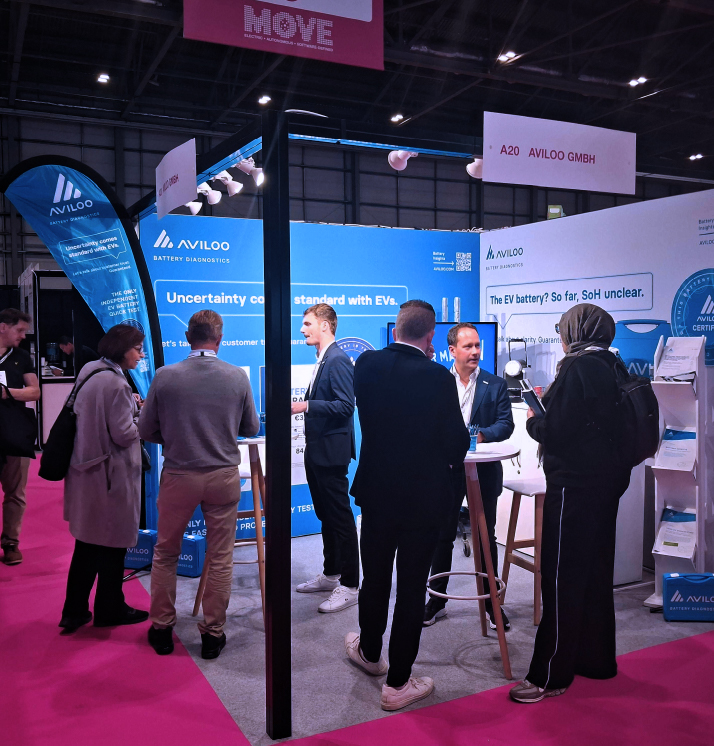
I spent time speaking with Stefan Holzschuh from AVILOO, a company specialising in EV battery testing and diagnostics.
For many buyers, the battery remains one of the biggest unknowns when purchasing a used EV. While mileage and service history are easy to verify, battery condition has historically been much harder to assess.
Companies like AVILOO are helping to solve that challenge by bringing greater transparency to battery health, helping owners, buyers, and fleet operators better understand the condition of a vehicle's most valuable component.
As EV adoption continues to grow, trust and transparency around battery performance will become increasingly important for the entire industry.
Making charging networks smarter
A few years ago, the focus for many charging operators was expansion. Today, the conversation is shifting.
Increasingly, operators are asking how they can improve reliability, maximise utilisation, and create better experiences for drivers.
That shift was evident during my conversation with Maren Rehnelt and Stefan Reins from EVAILABLE.
Their platform uses network data and predictive analytics to identify issues before they impact drivers, helping operators move from reactive maintenance to proactive management.
As Maren explained:
"We try to solve issues before anyone ever knows they exist."
It's a simple idea, but an important one. Every charger that works when a driver arrives builds trust. Every failed charging session damages it.
As charging infrastructure becomes more widespread, reliability may become just as important as expansion.
Unlocking the value of vehicle data
Modern vehicles generate enormous amounts of information, but much of that data remains difficult to access and utilise.
Christopher Hiller from Volteras shared how connected vehicle data is opening new possibilities across the mobility ecosystem.
From fleet management and charging optimisation to vehicle insights and new mobility services, connected vehicle platforms are helping organisations make better decisions using real-world vehicle data.
The automotive industry has spent decades focused on hardware. Increasingly, the competitive advantage is shifting toward software and data. The vehicles themselves are becoming intelligent, connected assets.
Mapping the real world
One of the most surprising conversations I had was with Martin Calmels, CEO at GeoPost Vision.
Most people know GeoPost through brands such as DPD and their parcel delivery operations. What many may not realise is that the company is also building one of Europe's largest street-level imagery platforms.
Using cameras mounted on delivery vehicles, GeoPost collects vast amounts of visual data while carrying out its normal operations. That data can then be used by mapping providers, autonomous vehicle developers, infrastructure operators, and many other organisations.
As Martin explained:
"We built the largest and freshest street-level imagery platform in Europe."
The implications are significant. Everything from road layouts and speed limits to charging locations and infrastructure changes can be captured and analysed, helping create a more accurate digital representation of the physical world.
Optimising what already exists
Another recurring theme throughout MOVE was efficiency.
Several conversations focused not on building more infrastructure, but on getting more value from existing assets.
Rolle Nieminen from Kempower discussed how their distributed charging architecture helps operators maximise available power and serve more vehicles without unnecessarily increasing grid requirements.
His explanation highlighted a broader trend visible across the entire event. The industry is moving beyond a period of rapid expansion and entering a phase focused on optimisation, utilisation, and operational excellence.
The question is no longer simply how much infrastructure can be deployed.
The question is how intelligently it can be used.
We’re making the right moves
What struck me most about MOVE 2026 wasn't any single technology. It was how interconnected everything has become. Autonomous vehicles rely on data. Charging networks rely on software. Batteries rely on transparency. Infrastructure relies on intelligence.
Each company I spoke with was solving a different challenge, yet all were contributing to the same goal: creating a smarter, more connected mobility ecosystem.
The technology may have changed, but the importance of bringing people together remains exactly the same.
And that's what events like MOVE continue to do best.
How Nexxt Industry supports the eMobility sector
For companies operating in autonomous driving, connected mobility, and eMobility, building great technology is only part of the challenge. Building market authority is what turns innovation into growth.
At Nexxt Industry, we help B2B tech companies build visibility, trust, and authority in fast-moving markets. Want to see how your brand performs today? Take the Market Authority Index test and discover your score.
For more industry insights and conversations, listen to our podcast and follow Nexxt Industry on LinkedIn to stay up to date with new articles, market trends, and eMobility news.